

This post contains affiliate links.

Homemade kombucha starts with a SCOBY, sweet tea, and patience. Brew the first ferment for 7 to 10 days until it tastes tangy, then bottle it with fruit or juice for a second ferment that builds natural carbonation.
I’ve been brewing kombucha since before I started this site, long enough that I keep two SCOBYs going now in case one batch goes sideways. My kombucha site, Brew Buch, exists because people kept asking the same troubleshooting questions in the comments here, so if your batch smells like vinegar or your SCOBY looks strange, I’ve almost certainly seen it before.
Brewing kombucha at home comes down to patience and a few non-negotiables: clean equipment, the right ratio of starter tea, and resisting the urge to peek on day three. I’ve run this recipe through dozens of batches to land on a fermentation that’s reliably tangy without tipping into straight vinegar.

 save this recipe!
It’s a big day everyone! The day your intestinal microbiota have been begging you for. The day you say goodbye to expensive store-bought kombucha. The day you become a brewmaster!
The goal of this guide is to be your one stop shop for homemade kombucha brewage, from SCOBY-less to fermented perfection. No hopping around the internet or buying unnecessary gear. No fuss. No confusion. Because making homemade kombucha is so simple, and I hope after reading this you’ll give it a whirl! Let’s hop right to it.
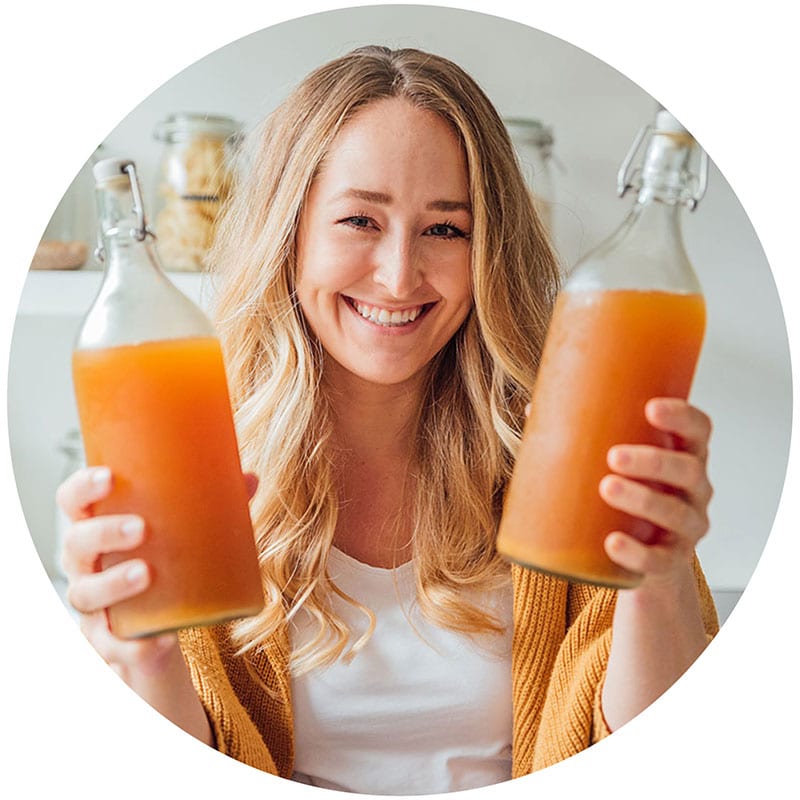
Meet The Brewer
Hey friends, I’m Sarah! I’m in love with home-brewing kombucha and have helped thousands of people all over the world make kombucha in their homes! I created an entire website dedicated to brewing kombucha called Brew Buch, and run an online community of over 50,000 brewers called Kickass Kombucha Brewers (I’d love for you to join)! If you have any questions about brewing, please drop a comment at the end of this post – I personally read and respond to them daily!
What is Homemade Kombucha?
Kombucha is a fermented tea drink made by adding a SCOBY (symbiotic culture of bacteria and yeast) to sweetened tea and letting it ferment for one to three weeks.
During fermentation, the SCOBY consumes most of the sugar and produces a naturally fizzy, tangy drink with a small amount of alcohol (typically less than 0.5%, similar to ripe fruit juice). The result is a lightly effervescent beverage that tastes somewhere between sparkling apple cider and tart lemonade, depending on how long it ferments and what flavorings you add.
Homemade kombucha goes through two stages. The first fermentation produces the base kombucha. The second fermentation, done in sealed bottles with added fruit or juice, builds the carbonation and adds flavor. Both are simple once you know what you’re doing!
What You Will Love About This Kombucha Recipe
I’ve been brewing kombucha at home for years, and this guide has now helped over 100,000 home brewers do the same. Here’s why it works and why readers keep coming back to it:
- Written for complete beginners with no brewing experience required
- Covers everything from growing your own SCOBY to second fermentation and flavor variations in one place
- Fully customizable! Once you have the base down, the flavor combinations are endless
How to Brew Kombucha:
This post will go into detail about each step in the process of making kombucha. For succinct instructions and metric measurements, jump to the printable recipe card at the end of this post. The general order of things goes something like this (you can jump around this tutorial by clicking the links below):
- Make SCOBY (1 to 4 weeks) – to make the “mother”
- First Fermentation (6 to 10 days) – to make the actual kombucha
- Second Fermentation (3 to 10 days) – to carbonate the kombucha

“Excellent recipe. I’ve tried ten or more online for comparison and this one has the best flavor balance. Not at all vinegary and not too sweet. Will be using for my base from now on.” -Katherine
Before we start, here are some general notes that are consistent throughout the whole homemade kombucha process.
- No metal or plastic containers. Metal can react with the acidic kombucha, while plastic can house nasty bacteria.
- Clean is key. A recurring theme in kombucha brewing is that everything must be clean! We’re creating the perfect environment for good bacterial growth, but if a bad bacteria sneaks in it could ruin your batch (and make you pretty sick).
- Temperature plays a big role. Fermentation goes a bit quicker in warmer temperatures and a bit slower in colder.
- No mold zone. If you see any mold growing on your SCOBY or in the tea (which I understand can be difficult to discern from the hideous SCOBY but will generally be green, white, or black), then toss your whole batch.
Supplies Needed for Making Kombucha
- Large Glass Jug: It should hold at least 1 gallon (buy on Amazon or in most homeware stores)
- Fermentation Bottles: These bottles have a tight seal specifically designed to keep the carbonation in (hellooo fizz!) (buy flip-top bottles here or collect and reuse GT’s bottles)
- A breathable cloth cover. A clean cotton cloth, coffee filter, or paper towel secured with a rubber band keeps dust and insects out while allowing airflow. The SCOBY needs oxygen during first fermentation.
- A long-handled wooden or plastic spoon. Avoid metal utensils in contact with the SCOBY or kombucha.
- A fine mesh strainer or cheesecloth. For straining before bottling.


Step 1: How to make a kombucha SCOBY
The SCOBY (symbiotic culture of bacteria and yeast) is the mother of the kombucha, providing bacteria and yeast to ferment the sweet tea, protecting the tea from outside contaminants, and providing a loose seal to keep a bit of the carbonation in. Yes, it’s hideous…but it’s the very essence of kombucha! And the best part? You can make one at home! You’ll need:
- Water: Tap water is just fine here!
- White Sugar: Feeds the yeast and bacteria—don’t sub with other sweeteners.
- Black Tea: Provides nutrients for fermentation. Black tea works best for a strong, healthy SCOBY.
- Raw, unflavored kombucha: Contains live cultures that kickstart the SCOBY growth. Look for one with sediment at the bottom!
To make a SCOBY, you’ll brew sweet black tea, let it cool, then mix in raw kombucha. Cover and ferment at room temperature for 1 to 4 weeks until a ¼-inch SCOBY forms. Keep the SCOBY in its tea until you’re ready to brew your first batch! Jump to recipe for printable instructions.

Which brand Is best?
Our tried and tested store-bought brand is the GT’s “Pure”. You can find it in most natural food stores.

Important Notes For Making A SCOBY
- Only black tea. Similarly, the SCOBY doesn’t grow as well with green or fruity teas. By all means, once your SCOBY is big and strong, you can use green tea, but for now, stick with black. The SCOBY doesn’t like decaf tea and will not grow as well if fed it (SCOBY = my spirit animal).
- No honey. Honey can contain botulism bacteria that, when grown exponentially as bacteria and yeast tend to do in kombucha, can be dangerous.
- Don’t mess with it! You won’t see anything but a few bubbles in the first few days. But then one day a thin, translucent layer will form, eventually thickening into a full on SCOBY.
SCOBY Care
A healthy SCOBY is pale, rubbery, and floats somewhere between the top and bottom of the jar. Brown stringy bits hanging off the bottom are yeast strands, not mold, and are completely normal. Mold shows up as fuzzy spots on the surface, usually blue, black, or white, and if you see it, the whole batch needs to be tossed.
Store your SCOBY in a “SCOBY hotel,” a jar with a cup or two of finished kombucha, whenever you’re not brewing. Keep it out of direct sunlight and covered with a breathable cloth, never a tight lid.

Step 2: The first fermentation
Steep the tea, dissolve in the sugar, and let it cool completely to room temperature before adding your SCOBY and starter liquid. Adding either to hot tea can kill the culture. Cover the jar with a breathable cloth secured with a rubber band and let it sit somewhere warm and out of direct light for 7 to 10 days.
Start tasting around day 7 using a straw to sample without disturbing the SCOBY. It should taste tangy with a light sweetness still coming through. The longer it sits, the more vinegar-forward it gets.
First Fermentation Tips
- In this step, unlike in the making of the SCOBY, you can use other teas besides black. Feel free to experiment with green, white, oolong, or combinations of them. Fruit teas should be mixed with a few black tea bags to ensure the SCOBY mama gets what she needs to thrive.
- Once the SCOBY gets to be about an inch thick, peel off a few layers to create a second SCOBY (you can share the love and gift this to a friend!)

Tea-to-Sugar Ratio
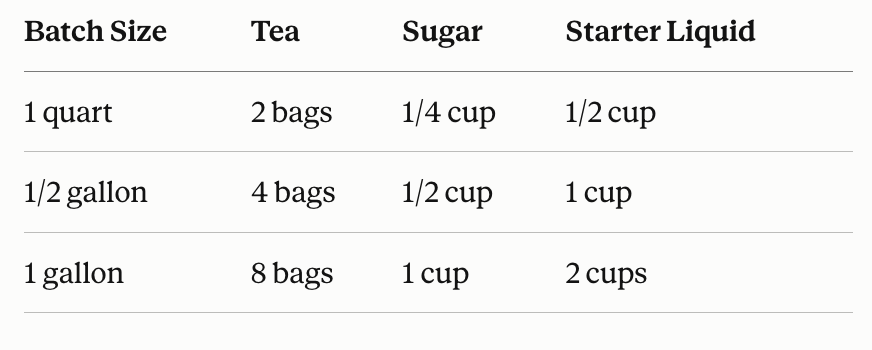
For every gallon of kombucha, use 8 bags of black or green tea (or about 2 tablespoons loose leaf) and 1 cup of sugar. The sugar isn’t for sweetness in the final drink, it’s food for the SCOBY, and most of it gets consumed by the end of the first ferment.
Step 3: The Second Fermentation
Once the first ferment tastes right, remove the SCOBY and set it aside in its hotel. Pour the kombucha into bottles, leaving about an inch of headspace, and add your flavoring of choice, fruit, juice, or herbs work well. Seal the bottles and let them sit at room temperature for 2 to 3 days to build carbonation, then move them to the fridge to stop fermentation.
Open bottles slowly over a sink the first time you try a new flavor. A strong second ferment can build more pressure than you’d expect. for 3 to 10 days to build fizz, then strain out fruit if needed and refrigerate to chill and stop fermentation. Jump to recipe for printable instructions.


Second fermentation tips
- The more sugar/fruit you add, the faster the kombucha will ferment and become carbonated.
- Your jars can explode if the pressure becomes too high! For your first few batches while you’re still getting the hang of how kombucha reacts to your environment, bottle a portion of it in a plastic bottle. This will act as a gauge for how the others are doing. When the plastic bottle is rock solid, the rest are probably done. “Burp” them by opening each to release some pressure, then place them in the refrigerator to slow fermentation.
Kombucha Recipe Storage and Shelf Life
Finished kombucha (after second fermentation) keeps in the fridge for 1 to 3 months in sealed swing-top bottles. Cold temperature slows fermentation significantly, so the flavor stays stable and carbonation is preserved.
At room temperature, kombucha continues to ferment, becoming more acidic and less sweet over time. Leave bottles out only during the second fermentation process, and refrigerate as soon as they reach your desired carbonation level.
A few storage tips worth knowing:
- Always store finished kombucha in glass, not plastic. Plastic can absorb flavors and may not hold carbonation as well.
- Burp your bottles every day or two during second fermentation to release built-up pressure and prevent over-carbonation.
- If you need to pause brewing, store your SCOBY in a glass jar with starter liquid in the fridge. It can stay dormant for several weeks this way.
- The SCOBY itself will keep indefinitely as long as it stays in liquid and the environment stays clean.
Kombucha FAQs
A first ferment usually takes 7 to 10 days depending on your kitchen’s temperature, and a second ferment for carbonation adds another 2 to 3 days.
Yes, as long as your equipment is clean and your SCOBY looks and smells healthy. A tangy, vinegar-like smell is normal. Mold or an off smell means it’s time to start over.s


Homemade Kombucha Recipe (How to Brew Kombucha)

Equipment
- Glass Jar (1 gallon or larger)
- Clean Cloth (like a dish cloth or paper towels)
Ingredients
Making a SCOBY
- 7 cups water, 1.6 L
- 4 bags black tea, or 1 Tbsp loose tea
- ½ cup white sugar, 100 g
- 1 cup unflavored kombucha, this should be unpasteurized, unflavored store-bought kombucha, 235 mL
First Fermentation
- 14 cups water, 3.5 quarts, 3.3 L
- 8 bags black or green tea, or 2 Tbsp loose leaf
- 1 cup white sugar, 200 g
- 2 cups unflavored kombucha, from a previous batch or store-bought kombucha, 470 mL
- 1 SCOBY
Second Fermentation
- Kombucha, from the first fermentation
- Sweetener or flavor
Instructions
Making Kombucha SCOBY
- Make Tea: Bring 7 cups water to a boil in a clean pot. Remove from heat and add 4 bags black tea. Allow tea to steep for about 15 minutes. Remove tea and stir in ½ cup white sugar. Let tea cool to room temperature.Alternatively, boil only 2 cups of water and add the remaining 5 cups of cold water once the tea has steeped and sugar has been added. This will quicken the process.

- Add Starter: Add 1 cup unflavored kombucha then pour everything into a large glass jar.

- Ferment: Cover with a clean cloth and secure with a rubber band. Set somewhere dark and room temperature (70-75°F, 21-24°C) for 1 to 4 weeks, until a ¼ inch (½ cm) SCOBY has formed.

First Fermentation
- Make Tea: Bring 14 cups water to a boil in a clean pot. Remove from heat and add 8 bags black or green tea. Allow tea to steep for about 15 minutes. Remove tea and stir in 1 cup white sugar. Let tea cool to room temperature.Alternatively to quicken this up, boil only 4 cups of water and add the remaining 10 cups of cold water once tea has steeped and sugar has been added.
- Combine With Starter + SCOBY: If your SCOBY is still in the jar you made it in, use a clean spoon to push it down into the tea, then pour out all but 2 cups of the tea that’s in that jar (you can bottle the remaining tea to keep as a strong starter kombucha). Pour in your freshly made cooled tea.

- Ferment: Cover with a clean cloth and secure with a rubber band. Set somewhere dark and room temperature (70-75°F, 21-24°C) for anywhere from 6 to 10 days. Begin tasting the tea at about 6 days. It should be mildly sweet and slightly vinegary when finished.The longer the tea ferments, the more sugar molecules will be eaten up, the less sweet it will be. This process will go faster if it is warm in your house.

- And Repeat: Reserve 2 cups from this batch to use as starter kombucha for your next batch (just leave it in the jar with the SCOBY). The rest can move into the second fermentation!

Second Fermentation
- Flavor: Add your desired flavors to each bottle, then funnel kombucha into bottles, leaving about 1 inch at the top. Seal each shut.

- Ferment: Let ferment somewhere dark and room temperature for 3 to 10 days.This process will go faster if it is warm in your house. Carefully open bottles to prevent volcanoes. You can do this over a bowl with a baggie over the top just in case!

- Serve: If desired, strain out flavorings before serving. Place bottles in the fridge to slow the carbonation process and to chill before serving.

Nutrition
Nutrition information is calculated by Sarah Bond, degreed nutritionist, and should be taken as an estimate. For the most accurate nutritional information, calculate it using the actual ingredients in your recipe.
 did you make this?Leave a comment below and tag @liveeatlearn on social media! I love seeing what you’ve made!
More Favorites from Live Eat Learn
About the gear
Above is a list of the supplies needed to make kombucha. These are affiliate links, meaning I may earn a commission if you make a purchase. I’ve only included products I know and trust, and have included multiple buying options for each. I personally use and love the products from Kombucha.com. For 10% off their online store, comment below and I’ll get our secret code to you!


Hi Sarah, thank you so much for this kick ass kombucha recipe! Since July I am brewing my own kombucha. The first few batches were awesome and very delicious. Since a month, the kombucha is going to taste quite acidic. I am shortening the second fermentation time and I am adding a little more sugar, but nothing helped so far. Could you give me a recommendation how to fix the acidity? Thank you so much! Cecile
Hi Cecile! I would not recommend changing the sugar; the ratio of tea to sugar needs to be as listed for the bacteria and yeast to ferment properly. I would personally just reduce the amount of time of the 1st fermentation, which is when most of the acidity develops. An easy fix! 😀
Well i think i got too excited to make my scoby ….I accidently used the raw organic multi green koumbucha for my starter is this going to work?
Hi Heather! While unflavored kombucha is really best for starting, you might as well just let it ferment and see what happens! If the multi green kombucha is watered down with any juices, it could influence the fermentation. I would start a second batch with unflavored to be sure, but leave this one just to see what develops! 😀
Thanks for sharing! I was intimidated by a starter. I have had 3 excellent batches of tea now.
Thank you very much for the instructions. So i followed your instructions and successfully made my scoby. Now I am about to start making my first fermentation but i have a question regarding your instructions shown below:
* cups (470 mL) unflavored starter tea (either from a previous batch or unpasteurized, unflavored store-bought kombucha)
for my starter tea, can i use the liquid that was left over after making my scoby?
Thank you
Hi Fredy! I used to believe that you couldn’t but I recently learned that this liquid might actually be usable. Doing some research of my own to come up with a solid answer. My official suggestion is still to use store bought for that first batch, but if you feel like experimenting it might just work (and I would love to hear how it goes for you!)
Hi, I am making an 18 litre batch of kombucha and I was wondering how many SCOBYs I should pop in. It’s all in one big container so I thought that maybe one SCOBY wouldn’t be enough…
Hi Dubhessa! Phew, 18L is a lot! Perhaps just throw in what you have? 2 or 3 should do (although it will grow its own SCOBY soon enough too).
Thanks for the detailed step by step! I’m excited to try it out. I’m sorry if you already mentioned it somewhere and I missed it, but if you are only periodically making kombucha how long can the SCOBY live in the reserve liquid of the first fermentation?
So exciting that you’re giving it a go! It depends on the temperature of your house (warmer = less time, cooler = more). I wouldn’t leave it for more than a month without adding a little extra tea in there for it to “feed” on!
What brand of kombucha do you use as a starter. I can’t find an unflavoured kombucha.
I was just using GT’s kombucha, but it seems to be harder and harder to fund unflavored kombucha these days. If you can’t find unflavored, aim for one with a very mild flavor, like ginger.
I’ve been making mine for years now and had to quit when we temporarily moved/shaked up with friends. Great, clear instructions!! Because I have auto-immune disease, MS, and cannot have ANY sugar, I let mine ferment extra long, until sugar is virtually eaten up, then sweeten with a drop of stevia:)
Such a smart way to sweeten it up, Mary! Thanks for the tip! 😀
Hi I am going to make a 2 gallon batch (okay try to make) of kombucha. I have bought a 2.95 glass container with spigot. I have 2 bottles of raw and organic 16oz bottles of kombucha plus I bought a scoby from health food store its about 3to4 inches wide. However I have been reading everywhere to use bottled distilled water. My tap water is clean wont it work?
Hi Laura! I haven’t found it necessary to use distilled (literally used tap water for every single batch I’ve ever made). Happy brewing!
I loved this clear description and am excited to start. I think my only unknown is where to buy the first unpasteurized kombucha to use as starter – you might tell people what type of store to find that at.
Hi Merie! When I first published this guide, unflavored kombucha was actually quite easy to find in any store that sold kombucha (ex Whole Foods). It has since become a bit harder. I’ll try to come up with a guide to finding unflavored!