

This post contains affiliate links.
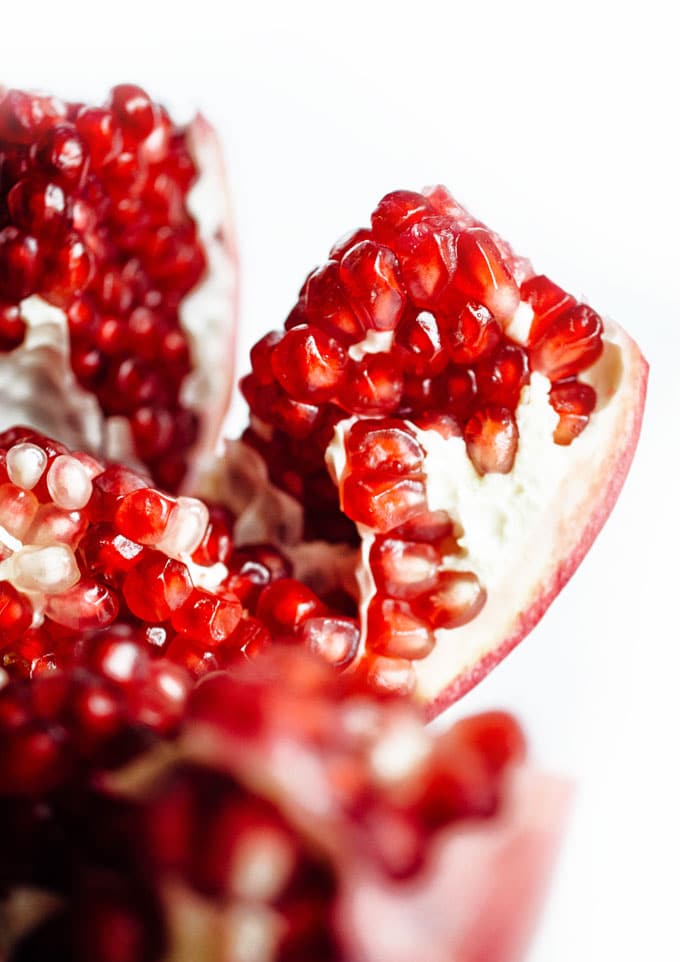
Everything you need to know about pomegranate. How to choose the perfect pomegranate, how seed it, how to store it, and more. Pom appetit!
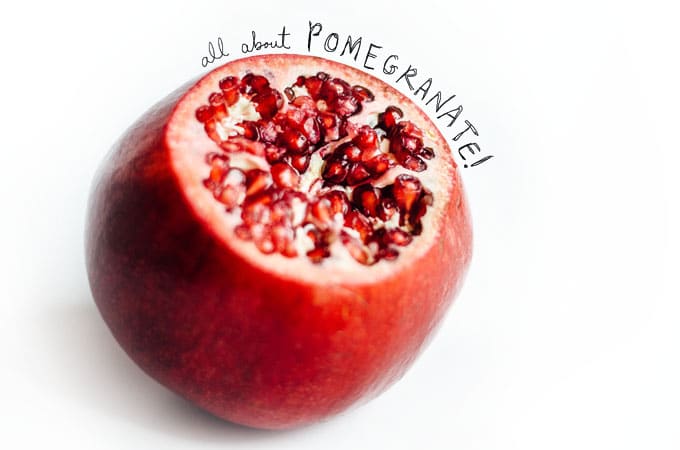
Folks! I just discovered that our childhoods were all LIES. Did you drink Shirley Temples as a kid? You know, ginger ale + grenadine + maraschino cherry? And did you just assume that this was a cherry flavored glass of heaven? Well guess what…it wasn’t cherry flavored! Apparently grenadine is a pomegranate-based simple syrup. I dunno, maybe that’s common knowledge…but it was news to me.
The “pome” in pomegranate comes from the Latin word for apple, and the “granate” from the word for seed. But “granate” may also have come from the Old French word for “grenat”, which describes the deep red color of the fruit. Am I the only one who thinks word history is awesome? Like here’s another one. The term for the scary exploding weapon “grenade” also comes from the French word for pomegranate. Pomegranate, the exploding grenade of sweet, juicy nectar!
How to Pick the Perfect Pomegranate
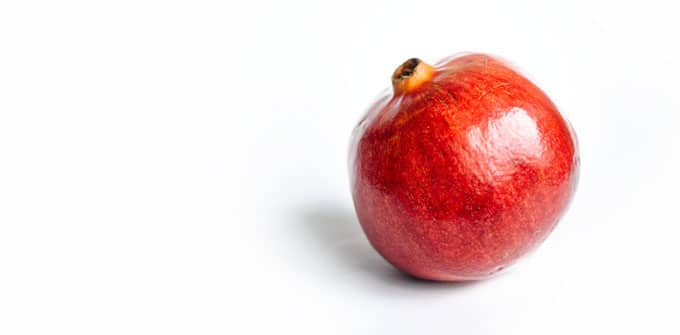
In the Northern Hemisphere, pomegranates are in their peak season from August to January, while in the Southern Hemisphere it’s just the opposite. Choose a pomegranate that has a deep, vibrant color, and that is a bit lumpy. A lumpy pomegranate is a hint that the seeds inside are becoming perfectly juicy! The unripe fruit will often be lighter and will make a hollow sound when tapped. And as is the case with most fruits, pomegranate should be heavy for its size with few scrapes or bruises.
Wondering how to deseed a pomegranate? This guide to cutting pomegranate covers it all!
And as a note, you can eat the entire pomegranate seed! The small hard seeds inside the juice are full of fiber (though you can spit them out of you don’t like the texture).
How to Store Pomegranates
- Whole: Store whole pomegranates at room temperature for several days, or place them in a plastic bag in the refrigerator for a few weeks
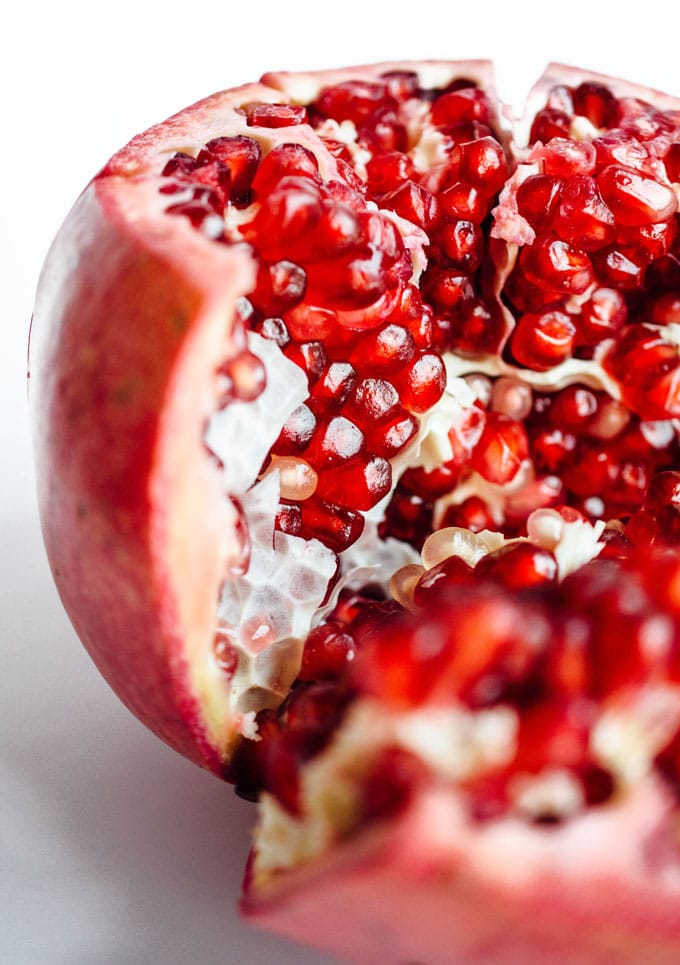
- Seeded: The seeds should be stored in an airtight container in the refrigerator for a few days, or they can be frozen in a single layer then stored in a freezer-safe container in the freezer. Note, they may lose their shape when thawed.
Our favorite pomegranate recipes
- Pomegranate Holiday Sangria
- Roasted Cranberry Pomegranate Salsa
- Frozen Yogurt Bark with Pomegranate and Dark Chocolate
- Bulgur Salad with Feta and Pomegranate
- Pull Apart Bread with Orange and Pomegranate
Pomegranate Nutrition Information
per 1 cup of pomegranate seeds (174 g)
- Calories: 144
- Carbohydrates: 32 g
- Fiber: 6 g, 28% Daily Value (DV)
- Protein: 2 g
- Fat: 2 g
- 36% DV of Vitamin K: A fat-soluble vitamin that allows for activation of enzymes in the clotting cascade, which is responsible for blood clotting. Also builds bone by modifying osteocalcin so that it may bind calcium, thus building the bone matrix.
- 30% DV of Vitamin C: A water-soluble vitamin that acts as an antioxidant to fight against potentially damaging free radicals (molecules with unshared electrons that float around wreaking havoc) and an important cofactor in collagen synthesis.
- 16% DV of Folate (Vitamin B9): A water-soluble vitamin that helps make DNA & RNA and metabolize amino acids.
- 12% DV of Potassium: A key mineral and electrolyte involved in countless processes, including healthy nervous system functioning and contraction of the heart and muscles.
- 10% DV of Manganese: A trace element that plays a role in healthy brain and nervous system function.


My kids love pomegranates and I need to get better at preparing them so they can eat something healthy but not really realize they’re choosing something healthy!
They’re sort of like nature’s jelly beans! I don’t know why I waited so long to make them a regular part of my diet. So tasty!
When I was growing up we would buy these all the time. My daughter picked one out at the store this week and can’t wait to open it. She always comments on how fun they are to eat. Added bonus that they are so good for you too!
Heck yea they are! Thanks for stopping by! If you come by the blog later in the week I’ll have a few pomegranate recipes posted as well! 🙂
I love pomegranates, but I do hate to peel so I sometimes buy them as seeds only. Expensive but love the burst of Vitamin C you get when chomping into them.
I didn’t know you could buy them pre-seeded, how handy! Because yea, they can be a bit of a pain/mess. The de-seeding under water method has been the best one I’ve come across, but it sounds like you found the truly best method, haha.
I love pomegranates and I don’t eat them nearly enough. Your pictures look so delicious. I feel like I can eat them right off the screen!
For some reason it’s just so easy to forget they even exist until you’re reminded of them. I wish I could send some your way, I have so many leftover!
Very neat, thanks guys!! 🙂
how long will they last in a centerpiece?
Love the idea, Lin! You can keep it as a centerpiece virtually forever (my grandpa has one that’s 30 years old, hahah). If you want to eventually eat it, I would suggest 1 to 2 weeks if its at room temperature (2 months if in the fridge).
I have found a way to get the pomegranate seeds out in under a minute. Just take the pomegranate and score a thin line around the fruit with a sharp knife. Then take your thumbs and brake it open into halves. Next put the cut side down in your hand over an empty bowl and whack the back of the fruit with a heavy wooden spoon and the seeds will fall out. Then do the other half the same way. Then just pick out the white pulp and you are ready to enjoy your fruit. (No water, no splatters)
Thanks for the tip, Keith! I’ll have to try that! 😀
I was wondering if you could tell me the lysine to arginine ratio contained in pomegranates and pomegranate juice.
Hi John! Well this is a tough question. I’ve checked a few of my routine sources of nutrition information and I can’t seem to find your answer anywhere! Pomegranate doesn’t pop up in most lysine to arginine ratio comparisons, so perhaps the values aren’t out of the ordinary for fruit? Sorry that I couldn’t be of more help!
I too would be concerned with the arginine content of the seeds. Most seeds and nuts are high in arginine and not well tolerated by some.
I wonder if you ever found out the lysine arginine ratio I was just trying to find out myself because I think pomegranate might be triggering cold sores 😞
thank you for giving me wonderful information
Did you know, that the pomegranate is Hades sacred fruit? Hades is the God of the Underworld, in Greek Mythology.