

This post contains affiliate links.

Here is everything you need to know about the infamous Dutch dairy, Gouda cheese! The making, types, flavor, how to store it, nutrition info, and more.
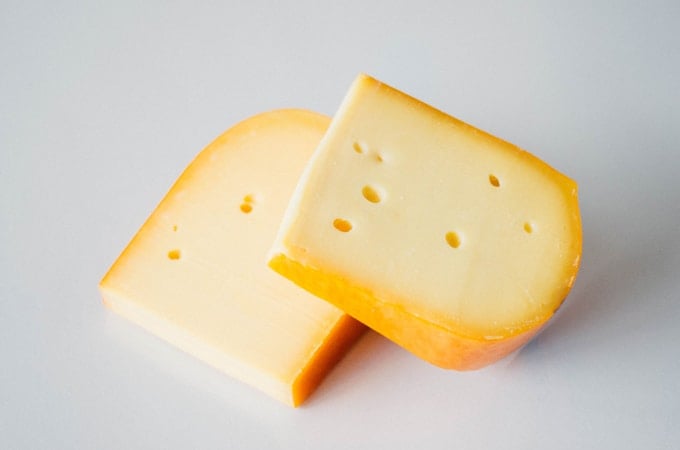
I’ve been calling the Netherlands home for a whole month now, so it’s time we get cooking again! And what better way to kick off life in the Netherlands than by celebrating with cheese! Gouda cheese, of course. So as always, we’re kicking off this Gouda cheese cooking spree with a rundown of the basics of Gouda cheese. Here’s everything you need to know!
Where does Gouda cheese come from?
Contrary to what you might think, Gouda cheese is not actually made in the city of Gouda, but rather, it is traditionally bought and sold in Gouda. Way back in the Middle Ages, towns could earn the rights to trade certain commodities. The town of Gouda had the rights to trade cheese, so that’s where people went to buy and sell cheese!
Nowadays, “Gouda” refers more to the style of cheesemaking than the actual cheese, as Gouda cheeses can vary widely depending on age. For this reason, the name “Gouda” isn’t protected or meant to define only the cheese coming from Gouda. If you want the real deal, look for “Noord-Hollandse Gouda”, as this title is protected and can only represent true Dutch Gouda made with Dutch milk.

How is Gouda Cheese Made?
So how is Gouda made? When cultured milk curdles, some of the liquid whey is removed and replaced with warm water, which is then drained. This is known as “washing the curds”, and it helps to remove extra lactose, therefore preventing some of the lactic acid formation. The curds are then pressed into round molds and are plopped into a brine (salt water) bath. The cheese is then set out to dry, coated in wax or plastic, and aged for anywhere from one month to over one year.
How do you pronounce Gouda?
And if you’re trying to be a real cheese connoisseur, you’re going to have to pronounce it right. While in America we pronounce it “g-OOO-dah”, it’s actually pronounced “(g)h-OW-da”. We don’t have anything like the sound of the Dutch G in English, but it’s almost like you’re clearing the back of your throat or are gargling. Cute right?
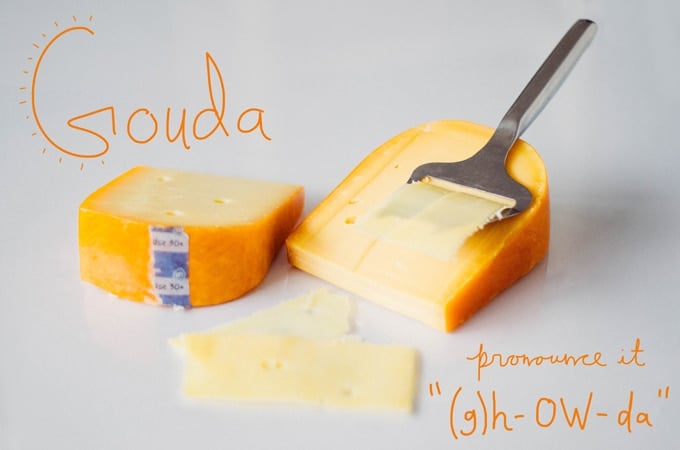
Types of Gouda Cheese
Perhaps I’d just never paid as much attention to cheese in America as I have since living in the Netherlands, but I’ve noticed that the common classification of cheese in the grocery is either “jong” (young) or “oud” (old). Digging a bit deeper, the Dutch actually classify their cheeses into six categories based on age:
- Young or New Gouda: aged 4 weeks
- Young Matured Gouda: 8 to 10 weeks
- Matured Gouda: 16 to 18 weeks
- Extra Matured Gouda: 7 to 8 months
- Old or Fully Matured Gouda: 10 to 12 months
- Very Old or Very Aged Gouda: over 12 months
What does Gouda cheese taste like?
The younger Gouda cheeses will have a more mild, soft, and almost sweet taste and texture. They’re best on sandwiches or crackers. The older Gouda cheeses become harder, stronger, and darker, taking on a buttery and nutty flavor. The deep flavor of the older Gouda makes it great for cooking (like in some Gouda mac n’ cheese), with crusty bread, or with wine.

What’s the white stuff on my cheese?
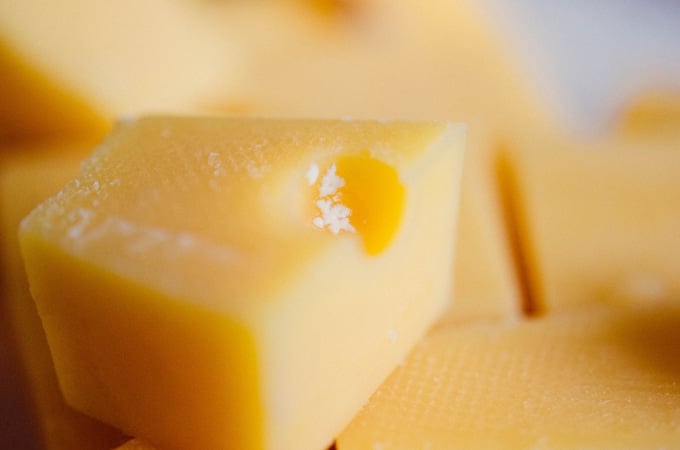
In the older/more matured Gouda cheeses, you may find crunchy, white crystals throughout the cheese. This is often confused with salt crystals, which sometimes form on the outside of the cheese as result of the brine bath. The clusters inside the cheese, however, are actually bits of tyrosine, an amino acid and the sign of a well-aged cheese!
How to Store
Cheese is a living, breathing thing, so it’s best not to suffocate it in plastic. Wrap your Gouda in parchment paper, then loosely wrap that in plastic. Set in the warmest area of the fridge, like in a vegetable drawer near the bottom. Gouda should last 2 to 3 weeks. Freezing alters the texture of the cheese, so I would recommend against it unless you absolutely must.
Gouda Cheese Recipes
Here are a few of our favorite recipes to cook with Gouda cheese:
- Apple Gouda Hand Pies
- Gouda Cheese Crisps
- Zucchini Cheese Bites (use in place of cheddar)
- Roasted Pepper and Gouda Grilled Cheese
- Butternut Mac and Cheese (use in place of cheddar)
- Ultimate Vegetarian Cheese Board
Nutrition Information for Gouda Cheese
per 100 g (3.5 oz)
- Calories: 356
- Carbohydrates: 2 g
- Fiber: 0 g
- Protein: 25 g
- Fat: 27 g
- 70% Daily Value (DV) of Calcium: 1% of the calcium in your body plays a vital role in vascular contraction/dilation and nerve transmission and signalling. The other 99% supports teeth and bone structure and function.
- 26% DV of Vitamin B12: A water-soluble vitamin important in brain and nervous system function as well as red blood cell formation. It is only found naturally in meat and animal products, but can be made industrially via bacterial fermentation.
- 26% DV of Zinc: A mineral important in strengthening your immune system, healing wounds, and maintaining your sense of taste and smell.
- 20% DV of Riboflavin (Vitamin B2): A water-soluble vitamin that acts as a component of FAD to help your body break down macronutrients in the electron transport chain, creating usable energy.
- 11% DV of Vitamin A: Provides the preformed version of the this fat-soluble vitamin, meaning it comes from an animal source. It is essential in many components of healthy vision, as well as immunity and cell growth/differentiation.


Thanks, Emma! Yea I was surprised by that one too! Good for when you need a good cheese fact/party trick 😉
There’s a cheese museum in Amsterdam?! I must go! I typically just walk through all the cheese shops, sampling them til I’m stuffed 🙂 Thanks for dropping by, Helen!
I’m with ya! And YES to Gouda for dessert. If you come back next week I’ll be posting Apple Gouda Hand Pies for the blog’s birthday 🙂 Thanks for stopping by, Marisa!
We used a wheel in a recipe covering with pie crust The cheese melted but it looked like a fish scale was around it. We are pretty sure we removed the wrapping. Should it have looked like that?
Hi Maggie! That’s so strange and I’m not entirely sure what would have cause that. Sometimes they’ll coat a wheel in (edible) wax, perhaps it was that? Sorry I can’t be of more help!
dank je Sarah for educating me on such a yummy delicacy. There’s a small family owned/run cheese factory close to where I live and this family came from Holland, and all they make and sell is Gouda. One of my favorite places to visit and all this time had no idea the history of Gouda until now.
Aw so fun that you can get real Gouda cheese by where you live. As we say in Holland, eet smakelijk (enjoy your food)!
I starting to learn to make Gouda cheese so I want to kmow everything how they do
While I have never personally made Gouda cheese, these instructions may be able to help you out.
What % of the fat in Gouda is saturated fat?
About half of the fat is saturated!
Grilled cheese inside out ; 1/4 thick slice fried in butter on cast iron skillet about 1 minute until golden brown on both side , then put on what ever type of buttered bread you like, and fry in skillet. As an extra additive real bacon bits, or little pepperoni cooked lightly before putting on the bread then add the cheese.
What about boerenkass cheese? This is the “good stuff”and the good gouda I’m always looking for and can’t seem to find. It’s not even mentioned in your article. Why’s that?
It’s simply the best, mild or aged, but never found in the grocery store, only in specialty import outlets. Why’s that?
I want to know more about the ever-illusive, Dutch Farm Cheese.
Boerenkaas is usually made form unpasteurized milk on a much smaller scale, which would explain why you don’t often see it in U.S. super markets. If you want something REALLY tasty you’ve got to try graskaas, which is the cheese made from the milk of cows who ate the first grass of the spring. It’s so delicate and delicious! 😀
Dank u wel.
Alle beste.
Paul – Utah